
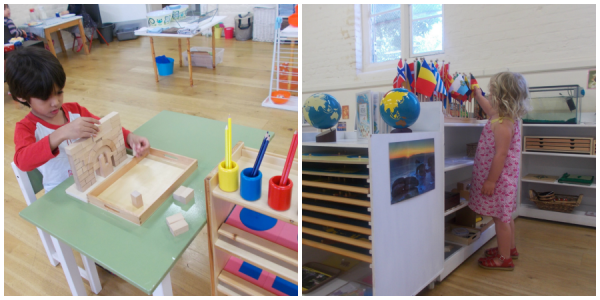
Around the age of 3 children from the Infant Community move in to Children’s House. This can sometimes happen earlier, depending on the child and their readiness.
The areas of learning in the Children’s House are divided into 5 areas. The Directress (preferred title for a Montessori teacher), child and the environment create a learning triangle. The environment is prepared to encourage independence, freedom within limits and a sense of order. The children’s innate passion for learning is encouraged by giving them opportunities to engage in spontaneous, purposeful activities with guidance from the directress. Through their work the children develop concentration and joyful self-discipline. Within a framework of order, the children progress at their own pace and rhythm, according to their individual capabilities.
Practical life. Activities in this area allows the child’s natural urge to independence. The Practical Life activities helps the child to perfect the skills they need in daily life. Activities like washing, sweeping, pouring, polishing are organised to enhance the development of the child’s concentration and coordination of movement. Successful completion of each task gives children a real sense of their achievement and building their self-confidence.
Sensorial. The materials in this area encourage children to order and classify the physical properties of the world they live in. These activities stimulate and develop the senses, refining children’s power of observation, perception, exploration and communication.
Mathematics. The maths materials are specially designed equipment which help children to grasp concrete ideas along with sensory experiments of numbers, quantities and mathematical operations. The Montessori math’s activities help the child to develop a true understanding of the concepts of shape, size and numbers leading on to the processes of addition, subtraction, multiplication and division.
Language. Montessori environments are rich with language. The child learns to express themselves. The freedom offered to the child creates opportunities for them to communicate with their peers and adults. They are helped to extend their vocabulary through stories, rhymes, songs, role play ad the Montessori activities. At the appropriate time in their development they are taught the sounds of the letters using Montessori’s unique sandpaper letters. The children learn to read and write at their own pace within a carefully planned phonetic scheme.
Culture. Science, Geography, Art and Music are integrated into the whole learning experience. The Montessori approach covers a wide range of subjects which reflect the broad interest of the young children. There are many activities in the environment that stimulate the children’s interest and help organise their sensorial impressions of the world around them.
 Grace Montessori School